



The space between neurons also “thinks”. A study reveals how its shape influences brain communication

A study led by the Instituto Biofisika (CSIC, EHU), in collaboration with a laboratory in the United States, shows that the shape of the space surrounding neurons influences how brain signals are transmitted
When we think of the brain, we usually imagine neurons sending messages to one another. However, a new scientific study demonstrates that the space between those neurons also plays a fundamental role in how the brain functions.
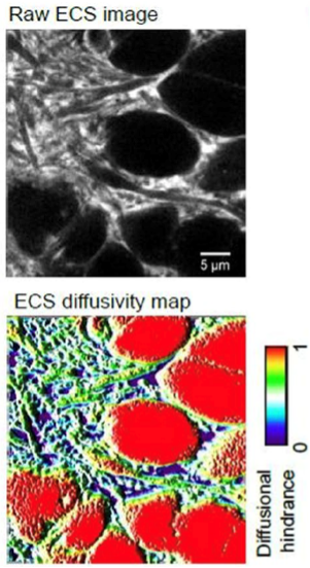
The research, published in the journal Fluids and Barriers of the CNS, was led and directed by Jan Tønnesen, a researcher at the Instituto Biofisika (CSIC, EHU), as part of an international project in collaboration with a laboratory in Texas (United States). This study reveals that the shape and organization of this microscopic space—known as the extracellular space—directly influences how chemical signals are transmitted in the brain.
When one neuron communicates with another, it releases chemicals called neurotransmitters, which must travel through that space until they reach their destination. Until now, it was thought that this environment was merely a passageway. However, the new study demonstrates that it is not a passive space, but rather one that can facilitate or hinder the movement of these signals, influencing the speed and precision of neuronal communication.
The research team has observed that this effect depends on the type of synapse—that is, the point of contact between neurons. In excitatory synapses, which trigger neuronal activity and are linked to processes such as learning and memory, the shape of the environment helps the neurotransmitter clear away quickly. This prevents interference with nearby synapses and allows each connection to function independently and precisely.
In contrast, in inhibitory synapses, which serve to slow down and regulate brain activity, the environment promotes the lateral spread of the neurotransmitter. This reinforces a background signal that helps maintain the balance of brain activity and prevents overexcitation.
To reach these conclusions, the team combined ultra-high-resolution microscopy—capable of observing the brain at very small scales—with computer models that simulate how molecules move in actual brain tissue.
“Our results show that the space between neurons is not just an empty gap, but an active part of the system,” explains Dr. Tønnesen. Co-author and member of Tønnesen’s research Paula Gimenez adds: “The brain’s very structure helps signals to be transmitted more efficiently.”
This discovery opens new avenues for better understanding how the brain works and how changes caused by aging, brain injuries, or neurological diseases can affect neural communication.
The study underscores the importance of viewing the brain as an integrated whole, in which not only the neurons matter, but also the environment in which they communicate.
For more information:
Alejandra Pinedo
Communication and Outreach manager
Tlf. 676751102