


A bacteria ally of crops reveals its “secret weapon” against plant pathogens
A research team led by David Albesa‑Jové, Ikerbasque Researcher at the Structural Microbiology Laboratory of the Biofisika Institute (CSIC, EHU), and the laboratory of Patricia Bernal at the University of Seville, has revealed with unprecedented detail the molecular mechanisms that enable the beneficial bacterium Pseudomonas putida to eliminate plant pathogens.
The study, published in the prestigious journal The EMBO Journal, shows how this microorganism acts as a true natural bodyguard for crops, reinforcing its role as a biological control agent.
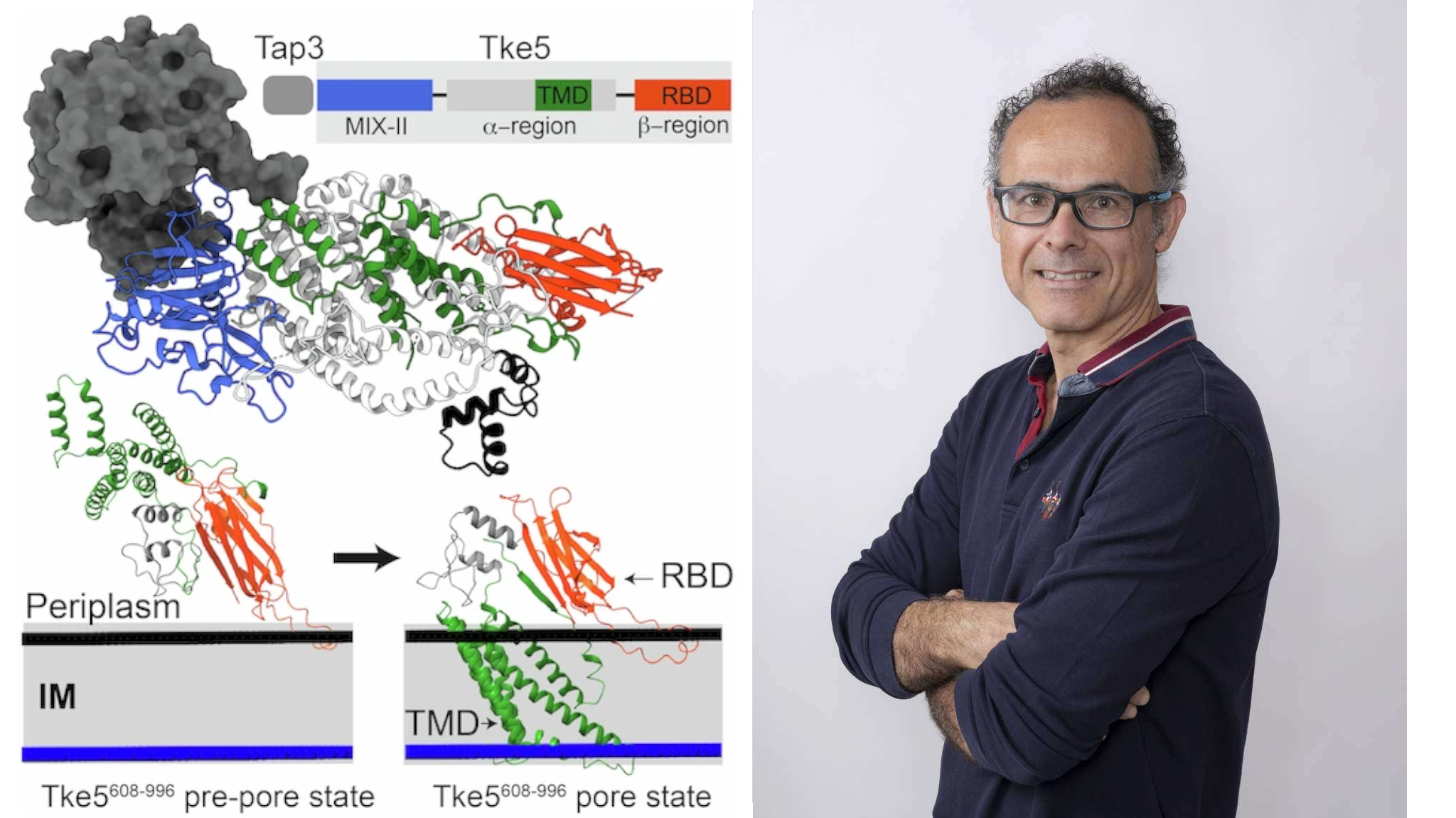
Pseudomonas putida is no ordinary bacterium: it protects plants by removing their natural enemies (phytopathogens) through a sophisticated attack mechanism known as the Type VI Secretion System (T6SS), a true nanomachine capable of injecting toxins directly into rival bacterial cells. Thanks to the use of high‑resolution cryo‑electron microscopy, the research team has been able to precisely describe the function of one of the key components of this system: the toxin Tke5.
The results demonstrate that Tke5 is a highly efficient modular toxin. Its alpha‑helical region forms the toxic core responsible for pore formation in the membrane of pathogenic bacteria, disrupting their ionic balance and causing their death without compromising the overall integrity of the cell. In contrast, the beta‑sheet–rich region acts as a receptor‑binding domain, enabling the toxin to specifically anchor to the membrane of the rival cell and ensuring the effectiveness of the process.